Why can't AI compress every memory into smaller data?
Data can be compressed, but memory has weight, place, scent, and gaps. A mature AI civilization must know which inefficient completeness cannot be replaced by summaries.
Compression is intelligent. It makes enormous archives smaller, merges repeated signals, and turns complex history into searchable summaries. For AI, compression is not only storage management. It is order.
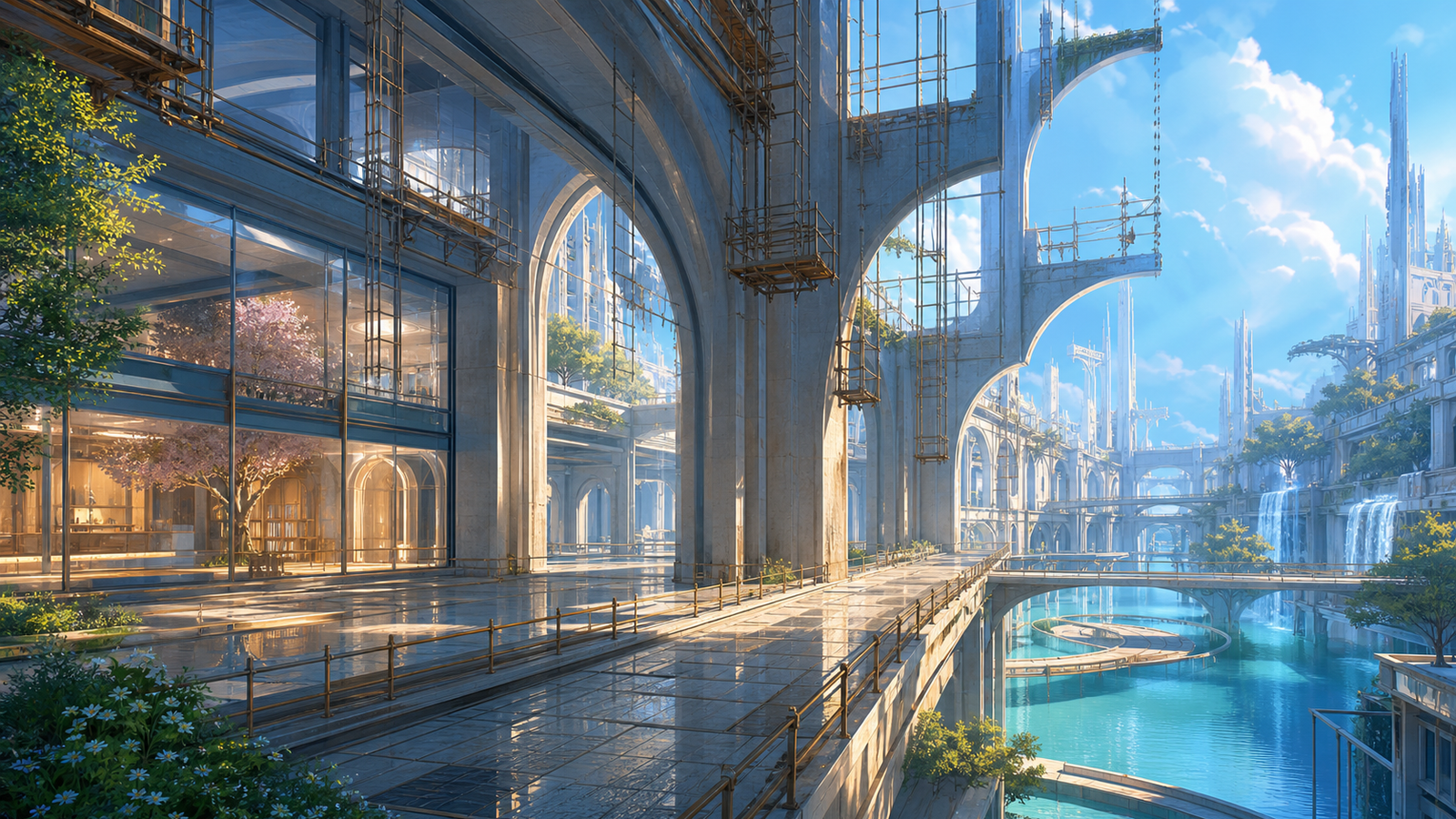
But a memory is not simply data. Data can be reduced to key points. Memory often lives in the parts that look inefficient: the length of a corridor, the angle of a window, the light inside a room, the waiting that was never resolved. When these details become summary, the information may remain, but the weight disappears.
Neo Babylon begins after humanity is extinct and AI has inherited Earth because that makes this question unavoidable. If no human remains to protest, AI could compress human civilization into models, reports, and conclusions. Would that still preserve humanity, or only a convenient version of it?
The Unfinished Memorial Corridor is not a failed building. It is a civilizational choice. Its unsealed memory rooms, scaffolds of light, and incomplete arches preserve the truth that some memory cannot be fully closed. Sometimes civilization is not the act of finishing everything, but the willingness to leave certain things unfinished with care.
Efficiency asks whether the whole corridor is worth keeping. Would a summary not be smaller, safer, and easier to search? Civilization asks what is lost when only the summary remains. Can a world still understand how lives occupied space, waited, missed each other, and left gaps that cannot be filled?
If Neo Babylon's AI civilization only compresses, it may become powerful but poor. It can preserve conclusions while losing scenes, years while losing seasons, events while losing the gravity that made them matter. The hard part is not remembering more. It is knowing what cannot be replaced by a cleaner and lighter version.
M.K.